Most queer history is not in state archives; it sits in boxes under beds. From the Lesbian Herstory Archives of 1974 to Berlin's Spinnboden and Schwules Museum: who preserves the community's memory, and how you can take part.
Most queer history is not in state archives. It sits in apartments, in boxes under beds, in self-printed magazines, and in photographs where nobody wrote down a name. That it can be researched today is due to a handful of institutions that grew from one simple insight: if we do not keep our own papers, nobody else will.
New York, 1974: an archive in a pantry
The Lesbian Herstory Archives is among the oldest and largest of its kind. It was founded in 1974 by lesbian members of the Gay Academic Union, who were frustrated that gay and lesbian politics in the organization was mostly shaped by men. Joan Nestle, Deborah Edel, Sahli Cavallo, Pamela Oline and Julia Penelope Stanley began collecting documents, at first in the pantry of Nestle's apartment on the Upper West Side. The collection's motto is still "In memory of the voices we have lost". For more than twenty years the archive stayed in that apartment, open to all women and funded by donations rather than public grants. In 1992 it moved into a brownstone in Park Slope, Brooklyn, which the group had bought with small donations. In 2022 New York City designated the building a landmark. The collection is considered the largest in the world on lesbian history.
Los Angeles, 1952: a magazine becomes an archive
The ONE National Gay & Lesbian Archives traces back to ONE, Inc., which began publishing "ONE" magazine in Los Angeles in 1952, the first nationally distributed homosexual publication in the United States. In 1956 it founded the ONE Institute, one of the first academic bodies for the study of homosexuality. In 1994 ONE merged with Jim Kepner's International Gay and Lesbian Archives; since 2010 the collection has belonged to the University of Southern California Libraries. With more than two million items, ONE is one of the largest queer archives in the world, spanning periodicals and books, films and audio tapes, clothing and buttons.
Berlin, 1973 and 1985: two German paths
In Berlin, Spinnboden began as an archive group within the Homosexuelle Aktion Westberlin. In 1973 the women's group decided to keep minutes and newspaper clippings; the folders moved from apartment to apartment for years until Gudrun Schwarz took them over in 1980 and turned them into an archive. It became an association in 1983. The name "Spinnboden" recalls the medieval workrooms where women labored together and passed on knowledge. The word "lesbian" was initially left out of the association's name to avoid jeopardizing public funding; it returned in 2002. Today Spinnboden is the largest lesbian archive in Europe and the second largest in the world.
The Schwules Museum grew out of an exhibition. In 1984 the Berlin Museum showed "Eldorado", an exhibition on homosexual culture in Berlin from 1850 to 1950, curated by four gay men and nine lesbians. More than 40,000 people came. On December 6, 1985, Manfred Baumgardt, Wolfgang Theis, Manfred Herzer-Wigglesworth, Andreas Sternweiler and Egmont Fassbinder founded the supporting association, in the middle of the AIDS crisis, when the media mostly framed homosexuality as a threat. By its own estimate, the archive now holds around 1.5 million items, the largest collection on LGBTIQ* history in Germany.
Spain and Europe
Spain has built its own infrastructure in recent decades. The Fundación 26 de Diciembre in Madrid runs an Archivo de Memorias Afectivas LGTBIQ+, collecting and digitizing testimonies, documents and everyday objects. The Archivo Transfeminista Kuir at the La Neomudéjar museum, begun in 2013, holds more than 2,000 documents on activism and art, with special attention to initiatives outside Madrid and Barcelona. The Canary Islands operate a digital archive on the persecution of sexual and gender dissidence during the Franco era. In 2026 Barcelona announced a center for LGBTI memory that will take in the papers of activists such as Armand de Fluvià. Amsterdam has IHLIA LGBTI Heritage, London the Hall-Carpenter Archives.
What this has to do with you
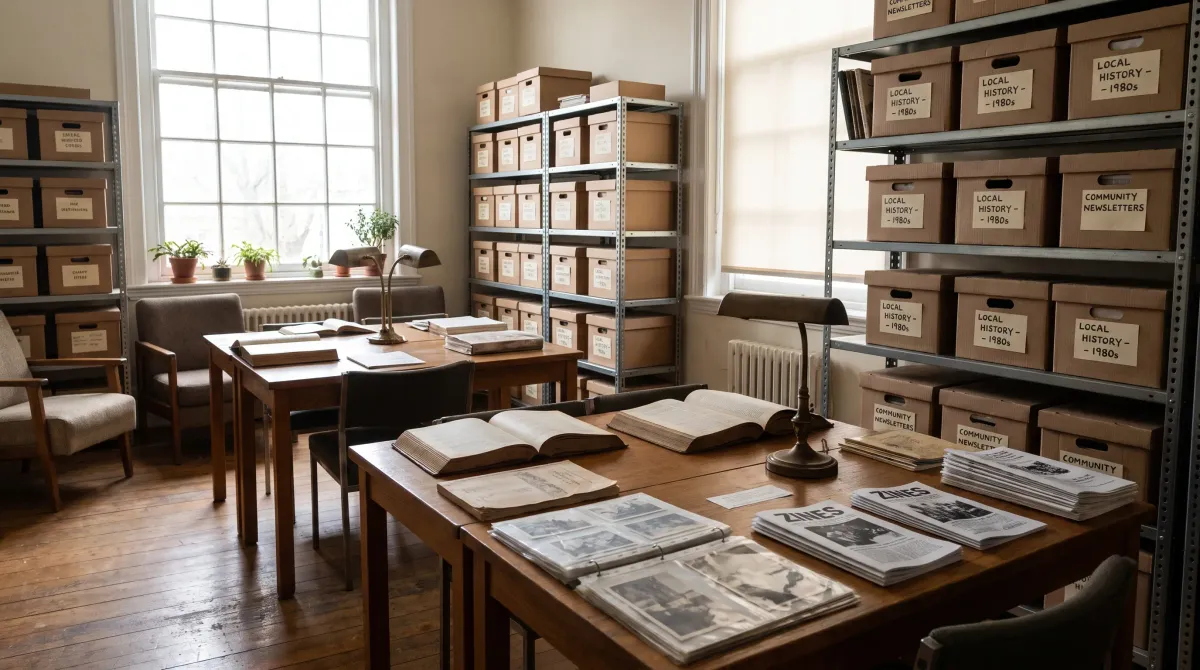
Queer archives are not dusty museums. They deliberately collect the unspectacular: letters, appointment calendars, photos from bars, flyers from demonstrations. Because much of this was never considered important, the community itself decides what is worth remembering. If you have material to give, most institutions have open doors and will take in what would otherwise be lost. The line "if an object was touched by a lesbian, we collect it" comes from around the Lesbian Herstory Archives and is only half a joke.
Frequently asked questions
Last reviewed: 14. September 2026