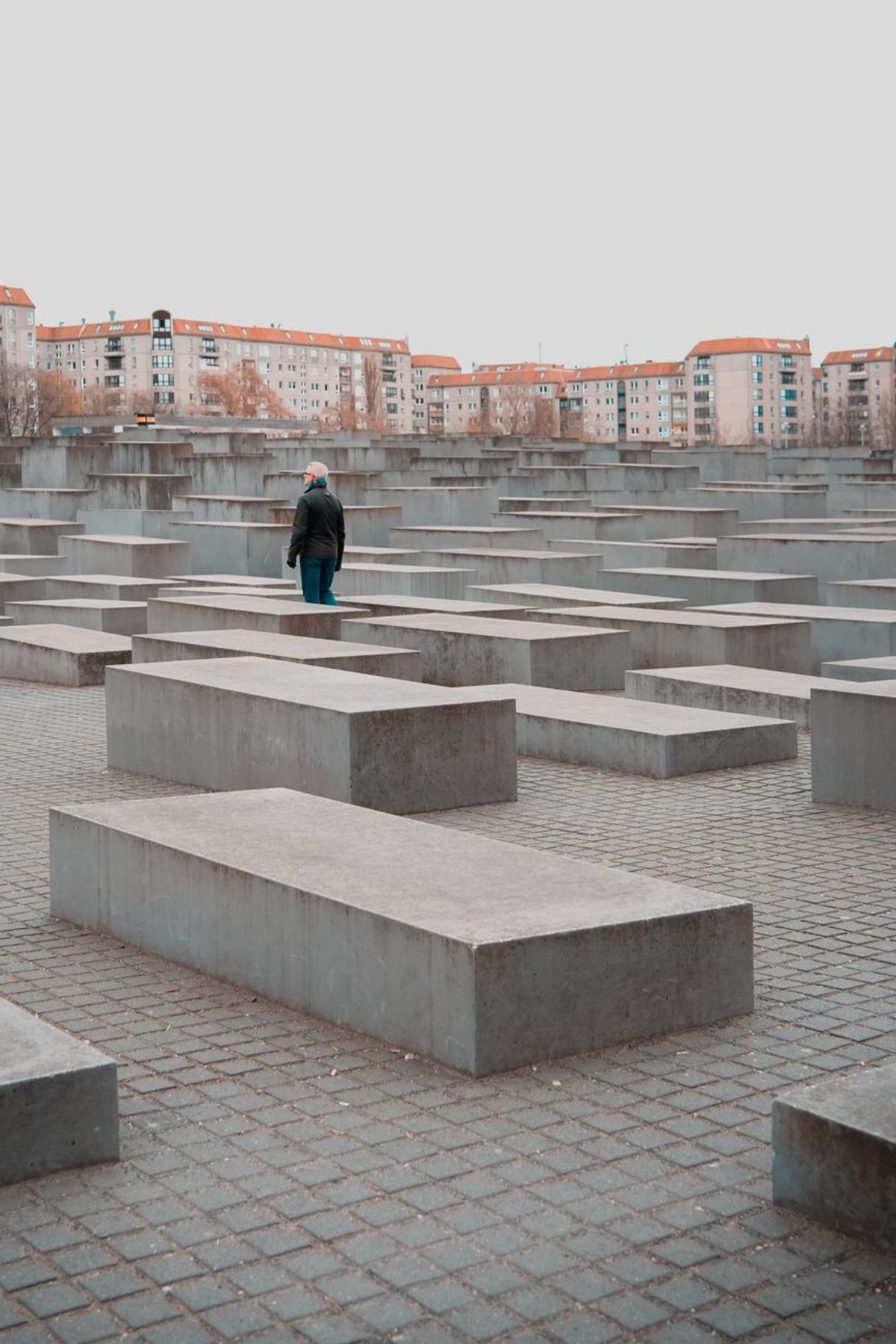
On the southern edge of Berlin's Tiergarten park stands a concrete block that echoes the shape of the stelae of the Holocaust memorial across the road. It is the Memorial to the Homosexuals Persecuted under Nazism. Look through the small window in its front and you see a film: two men kissing. This guide explains how the memorial came about, what you will see, and how to visit.
The background: Paragraph 175 under the Nazis
In 1935 the Nazis sharply tightened the ban on male homosexuality. According to the Foundation Memorial to the Murdered Jews of Europe, which looks after the site, this led to more than 50,000 convictions. Several thousand men were deported to concentration camps and made to wear a pink triangle. Female homosexuality was not prosecuted in Germany at the time, unlike in annexed Austria.
The Nazis also destroyed the social worlds of gay men and lesbians. After 1945 recognition did not follow: in both postwar German states, homosexual victims were long left out of remembrance. Many of those deported to camps died there of hunger, disease, abuse or targeted killings.
What happened to the law after 1945, and how Germany deals with those convicted today, is a chapter of its own. We have a separate article on rehabilitation and compensation.
How the memorial came about
The German Bundestag decided on 12 December 2003 to build it. The impulse came from the initiative "Remembering the homosexual victims of the Nazis" and the Lesbian and Gay Federation in Germany (LSVD, now LSVD+). The design is by the artist duo Michael Elmgreen from Denmark and Ingar Dragset from Norway, who have worked together since 1995 and live in Berlin. It was opened to the public on 27 May 2008.
The memorial is meant to honour the victims and to set a lasting sign against the exclusion of gay men and lesbians. That is the wording of the Bundestag decision, which the foundation quotes on its site.
What you see
The block takes up the shape of the Holocaust memorial's stelae opposite. A small square window is set into one side. Look through it and you see a film of two men embracing and kissing.
The film changes
After protests that the memorial addressed only gay men, the film is replaced every two years under a new arrangement, and an expert jury decides on each new film. According to the foundation there have been three so far:
- the first film by Elmgreen and Dragset, shown until 2014,
- "Kuss ohne Ende" (Endless Kiss) by Gerald Backhaus, Bernd Fischer and Ibrahim Gülnar, from 26 January 2012,
- a film by the Israeli artist Yael Bartana, from 3 June 2018.
The dates on the foundation's page do not fit together neatly: the first film is said to have run until 2014, the second from 2012. Which film is on now cannot be established from the sources, and no announcement of a change after 2018 turned up. Ask the foundation if this matters to you.
Ten years on: the ceremony in 2018
On 3 June 2018 the foundation, the LSVD and the Magnus Hirschfeld Federal Foundation marked the tenth anniversary at the memorial itself. Speakers were Federal President Frank-Walter Steinmeier, Berlin's then Governing Mayor Michael Müller, Günter Dworek as co-initiator and LSVD representative, and Gulya Sultanova of the LGBT film festival "Side by Side" in St Petersburg. Uwe Neumärker, the foundation's director, hosted. Yael Bartana's film began running that day. The foundation's announcement gives neither a title nor a description.
Visiting
- Address: Tiergarten, Ebertstrasse, 10117 Berlin, opposite the Holocaust memorial.
- Access: The memorial is open around the clock, every day.
- Accessibility: The foundation states that the site was assessed under the "Reisen für Alle" (Travel for All) criteria. Details are with the foundation.
- Information: The Foundation Memorial to the Murdered Jews of Europe looks after the site on behalf of the federal government. Its visitor service is at +49 30 26 39 43-0, and the foundation is based at Georgenstrasse 23, 10117 Berlin.
- School groups: Educational workshops exist for lower and upper secondary levels.
Further reading
The foundation's page lists four partners on the subject: gedenkort.de, rosa-winkel.de, blsb.de and berlin.lsvd.de. We have not checked what each of them offers.
To close
The memorial is free to visit and needs no booking. If you are in Berlin and want a place where the state explicitly acknowledges the persecution of gay men under Nazism, this is one.
Status of the information: November 2026, based on the foundation's pages (the memorial page and the announcement of the 2018 ceremony) and the Federal Agency for Civic Education. Check details such as the film programme before you go.
Frequently asked questions
Sources
- stiftung-denkmal.de · denkmal-fuer-die-im-nationalsozialismus-verfolgten-homosexue...
- stiftung-denkmal.de
- bpb.de · denkmal-fuer-die-im-nationalsozialismus-verfolgten-homosexue...